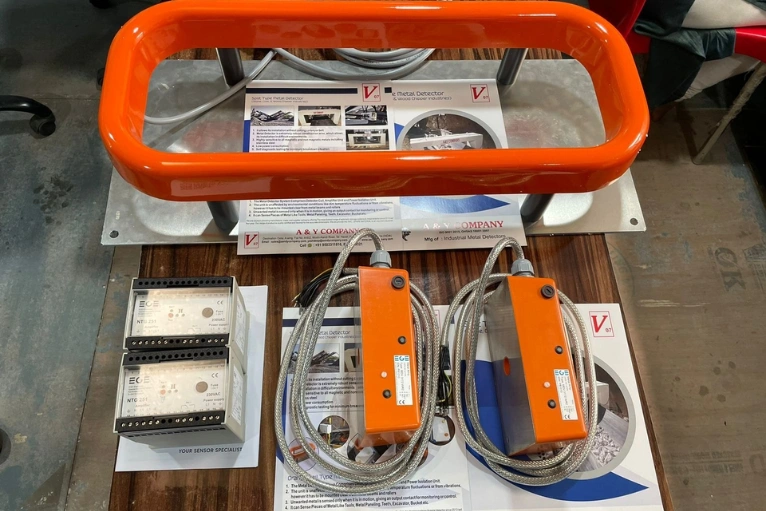
A tiny piece of unwanted metal can create a major problem on a busy production line. From raw material processing and food manufacturing to pharmaceuticals, packaging, and other industrial operations, detecting metallic contaminants at the right stage is essential for maintaining product quality and protecting machinery. Modern metal detection systems are designed to identify unwanted metal particles quickly and accurately without unnecessarily interrupting production. Choosing reliable Industrial Metal Detector Manufacturers in India can help businesses select detection solutions that match their production requirements, product characteristics, and quality control standards.
There are several points in manufacturing processes where raw materials, processing equipment, packaging materials, and manufactured products come in contact with different surfaces. However, in these processes, it is sometimes possible for unwanted metal pieces to be added to the production stream due to equipment wear, damaged equipment, or contaminated raw materials. It is crucial to detect these contaminants before products proceed beyond the production line in order to ensure uniformity.
Important reasons for the use of metal detection:
Color, flavor, size, or packaging are not the only things that affect the quality of a product. Also, manufacturers must make sure that the final products do not contain any extraneous materials. Any small piece of metal can have an impact on customers’ confidence and quality issues if it ends up in the final product.
The key points of how metal detection can help with quality:
Finding contamination as early as possible can make production management easier. Metal particles can get into a manufacturing process and not be identified until final inspection, which means that there may be a need to inspect or retain more products. If a problem is identified early, it can be isolated and minimise the disruption.
The optimum detection site will vary with manufacturing process, product nature and contamination site location. When dealing with Industrial Metal Detector Manufacturers based in India, it can assist them in understanding the appropriate system configuration for their particular manufacturing needs.
The advantages of early detection are:
Safety standards are an important responsibility in industries where the products are consumed or used directly by the customers. There are various other industries, such as food processing, pharmaceuticals, and others, that need to be able to control foreign materials as they are being produced. Metal detection can be part of a wider quality/safety management system.
Metal detection can aid safety by:
Various operational risks faced by manufacturing companies are equipment damage, contamination of the product, production halt, and rejection of the batch. When not detected in a timely fashion, metal contamination can be a factor in some of these issues. This type of risk can be better controlled by manufacturers with an adequate detection system.
Risk-reducing measures include:
Consistency, measurability, and incorporation of inspection tasks into the production flow are key components of quality control. In some cases, it is not always feasible to rely on manual inspection in the presence of high production volumes of product being manufactured quickly. Automated metal detection can give a secondary layer of inspection, without needing to manually inspect every product for metal.
Some quality control enhancements include:
Metal detection isn’t restricted to any one manufacturing area. Industries employ different detection systems based on their production process and contamination issues. Appropriate metal detection solutions can be used to help any of the following industries: food processing, pharmaceuticals, textiles, chemicals, packaging, plastics, and other manufacturing applications.
It is important to choose a metal detector that is not just sensitive, but also takes other factors into account. The system configuration can be affected by the product characteristics, the speed of the conveyor, the installation environment, the type of packaging material, the size of the contaminant, and the space available for production.
Factors that are important to consider are:
Modern industrial metal detectors are based on the principle of electronic detection and are able to detect or identify metal products as they move through the inspection area. The system generates a field of detection and tracks the changes caused by any metallic contaminants. Once a proper detection threshold is achieved, the system may set off an alarm or rejection mechanism, depending on its setting.
New detection technology provides:
Metal detection has become an important part of maintaining quality, safety, and reliability across modern manufacturing environments. From identifying unwanted contaminants and protecting equipment to strengthening quality control and reducing production risks, the right detection system can support several stages of industrial operations. Choosing experienced Industrial Metal Detector Manufacturers in India can help businesses find equipment that suits their product type, production speed, installation requirements, and inspection needs. With proper installation, regular testing, maintenance, and trained operators, metal detection can become a dependable part of a safer and more efficient production process.
An industrial metal detector is used to identify unwanted metallic contaminants in products or materials during manufacturing. It can detect different types of metals depending on the system design and application.
Industrial metal detectors are commonly used across food processing, pharmaceuticals, packaging, plastics, chemicals, textiles, and other manufacturing sectors where foreign material detection is important.
A metal detector provides an automated inspection step that can identify metallic contamination before products move further through production. This can help manufacturers maintain consistent quality and reduce the risk of contaminated products reaching customers.
Product characteristics, detection sensitivity, production speed, conveyor dimensions, installation environment, packaging material, and rejection requirements are some important factors to consider when selecting an industrial metal detection system.
Regular testing, proper calibration, preventive maintenance, suitable system settings, and operator training can help maintain consistent detection performance and support reliable operation over time.
Looking for the best Metal Detector in India? Well, we are the top Metal Detector Manufacturers in India. Best Manufacturers, Suppliers of Industrial Metal Detector, Stone Crusher Metal Detector, Crusher Conveyor Metal Detector, Stone Crusher Spare Part, Metal Detector Amplifier, NTG 251 Amplifier, Metal Detector Coil 650mm in India.
© Copyright 2026 VJS Electronix All Rights Reserved. and Developed By